Tree Removal in Calgary
Species risks, permits, costs, and what the process looks like.
Common tree species and their removal challenges
Calgary's urban forest is a mix of hardy deciduous and coniferous species adapted to our boreal-transition climate. Each has traits that affect how — and whether — they need to be removed.
🌳 Poplars (Aspen, Cottonwood, Hybrids)
Ubiquitous shade trees, but short-lived. Older poplars develop internal decay (heart rot) leading to hollow trunks. Weak wood means heavy branches shed easily in wind. Extensive surface root systems interfere with sidewalks and lawns. Old, rotting poplars are the most common removal target in Calgary.
🌲 Spruce (White, Colorado Blue)
Hardy evergreens with shallow root systems and dense canopies. Can uproot in high winds or saturated soil. Heavy snow loading breaks limbs in compromised trees. In older neighbourhoods, overgrown spruce near houses often require careful sectional removal.
🌳 American Elm
Beautiful arching canopies, but susceptible to Dutch Elm Disease — a fatal fungus spread by bark beetles. Infected elms will die and must be removed promptly to prevent spreading DED. Large size and numerous long limbs make removal complex.
🌳 Green Ash
Common boulevard tree valued for hardiness. Emerald Ash Borer (EAB) is an emerging threat in western Canada. Infested ash shows dieback and woodpecker holes. Once extensively infested, removal is usually necessary.
🌳 Birch (Weeping, Paper)
Popular ornamentals but high-maintenance in urban conditions. Relatively short lifespans. Prone to bronze birch borer and drought stress. Progressive crown dieback is common — once a birch loses large portions, removal is usually safest.
🌳 Manitoba Maple (Boxelder)
Fast-growing native maple with brittle wood and weak branch unions. Notorious for limb breakage — large scaffold branches can crack off in older trees. Stem cankers kill sections. Frequently removed when threatening structures or power lines.
Other species: Scots pine, lodgepole pine, and ornamental firs are found in various Calgary neighbourhoods. Willows and poplars along river valleys can require removal after storm damage. Ornamental flowering trees like plum and cherry may need removal if affected by black knot fungus, which is increasingly common in Calgary.
When removal is necessary
Trees add value, shade, and beauty — removal should be the last option. But sometimes it's the right one.
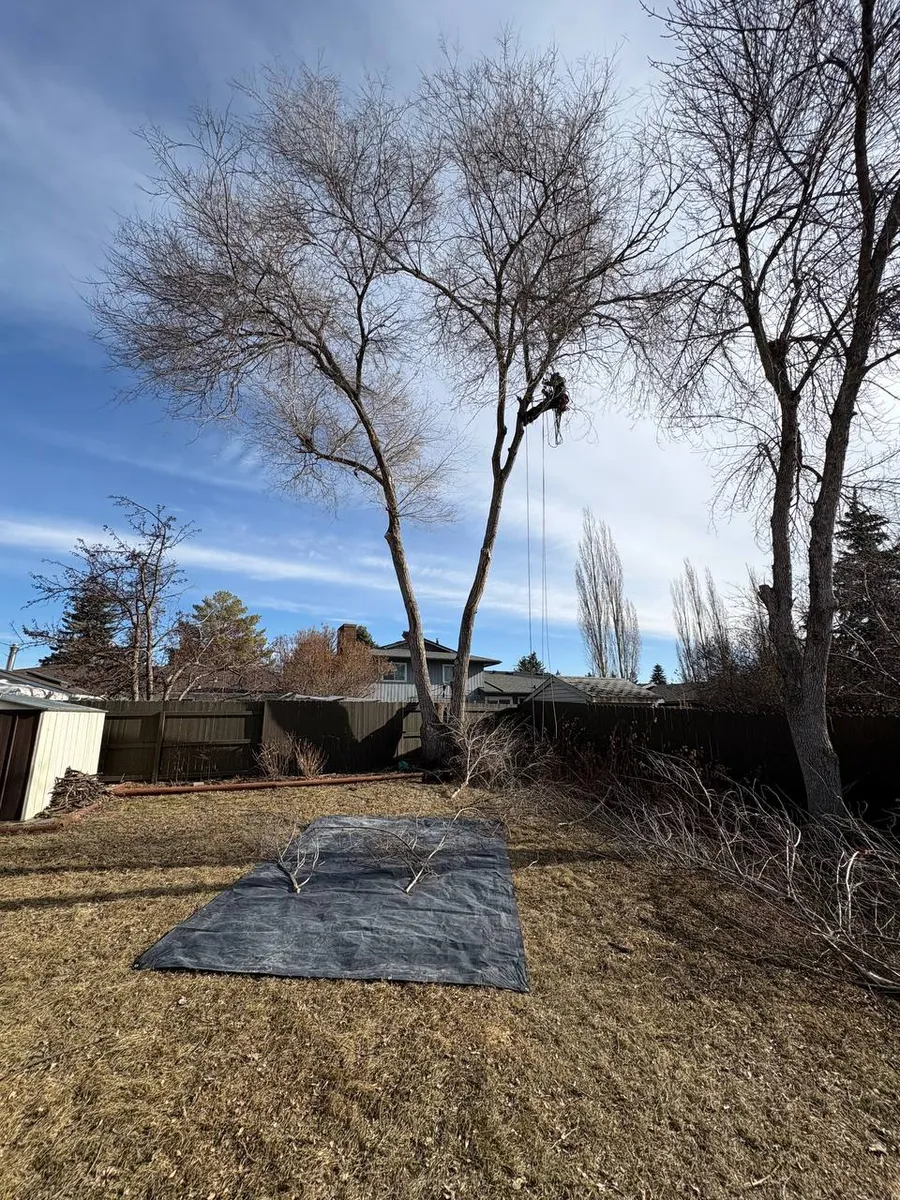
Dead or dying trees. A dead tree is a standing hazard. It will drop branches unpredictably, attract wood-boring insects, and eventually fall. Signs include: no leaves in summer, bark falling off in large sections, mushrooms at the base, heavy woodpecker activity, and brittle branches that snap without flex.
Structural failure risk. Trees with severe lean, cracked trunks, large cavities, or major root damage may be beyond saving. Co-dominant stems with included bark are a particular concern — they're prone to catastrophic splitting.
Disease. Some diseases are manageable with pruning. Others — particularly Dutch Elm Disease, severe wood decay, and advanced black knot — are fatal or uncontrollable.
Root problems. Roots lifting foundations, breaking into sewer lines, or severely cut during construction can destabilize a tree or cause ongoing property damage. When root issues are extensive, the tree often needs to come down before it comes down on its own.
Disease that can't be controlled. Dutch Elm Disease, advanced black knot on ornamental trees, and severe pest infestations like bronze birch borer or emerald ash borer leave trees beyond treatment. Once the canopy is more than half dead, removal is the responsible choice.
Too big for the space. Some trees simply outgrow their location — growing into power lines, damaging the roof with overhanging limbs, or shading out an entire yard. If pruning can't solve the conflict, removal may be the only realistic option.
Storm damage
Trees that lose more than 50% of their crown in a storm rarely recover well. The remaining structure is weakened and prone to further failure. Severe cases warrant removal.
Location conflicts
Sometimes healthy trees are simply in the wrong place — too close to a foundation, interfering with construction, blocking sightlines, or damaging underground services.
When removal might NOT be necessary
Not every tree problem means the tree has to go. Here are some common situations where an alternative approach may save the tree — and save you money.
Dead branches only?
If the trunk and main structure are sound, removing dead branches through pruning may be all you need. Deadwood pruning improves safety and appearance without losing the tree.
Leaning but stable?
A tree that has always leaned is often perfectly safe — it grew that way. If a lean develops suddenly, cabling and bracing can support weak structure and extend the tree's safe life by years.
Blocking light?
Crown thinning lets light through the canopy without removing the tree. A skilled arborist can selectively remove interior branches to open things up while keeping the tree healthy and balanced.
Just "messy"?
Seed pods, sap, cotton, or leaves are annoying — but they're not dangerous. If the tree is healthy and structurally sound, the mess is a maintenance issue, not a removal reason.
If you're unsure, we're happy to take a look and give you an honest opinion — even if the answer is "keep the tree."
Have a question that's not answered here?
Contact us — we're happy to help.
Safety and risk factors
Tree removal is inherently dangerous work. Calgary's urban environment adds complications that make professional service essential.
Proximity to structures
Most residential trees are within falling distance of a house, garage, fence, or car. The tree usually can't be felled in one piece — it has to be taken apart in sections, with each piece carefully rigged and lowered.
Power lines
Trees near power lines require specialized protocols. Only qualified arborists should work near electrical infrastructure. In some cases, Enmax must de-energize lines before work begins.
Decay and instability
Dead and decaying trees are unpredictable. What looks solid may be hollow inside. Experienced arborists assess internal condition before climbing and adjust their approach accordingly.
Weather
Calgary's wind, freeze-thaw cycles, and sudden storms add complexity. Work may need to be paused if conditions become unsafe. Safety always comes first.
Trees near power lines
If your tree is touching or within 3 metres of power lines, do not attempt any work yourself. Electricity can arc through branches, through you, or through metal tools. People die every year from contact with power lines during tree work.
ENMAX is responsible for line clearance on their infrastructure. Call them first — they'll send a crew to trim branches back from the lines at no charge to you. This can take a few weeks to schedule, so call early.
Once the area is safe and lines are clear, we can complete the removal. We can also make the ENMAX call for you if that's easier.
Emergency tree removal
Storms, high winds, and heavy snow can cause sudden tree failures. Here's what to do in an emergency:
Emergency work typically costs 25–50% more than scheduled removal due to urgency, overtime, and equipment mobilization. That said, safety comes first — and we'll always give you an honest price before starting work.
Permits and bylaws
🚫 Elm trees
Specific rules. You cannot prune or remove an elm between April 1 and September 30, except in emergencies. Elm wood must be disposed of properly — it cannot be stored as firewood.
🏙️ City-owned trees
Boulevard trees and park trees require City of Calgary approval before any work. These are on public land — even if they overhang your property.
📜 Protected areas
Some developments, new communities, and condo complexes have tree protection covenants that restrict removal. Check your land title or HOA rules if unsure.
What affects removal cost
Most residential tree removals in Calgary cost between $400 and $1,200, though large or complex trees can exceed this. Here's what drives the price:
Tree size
A 6-metre poplar is very different from a 20-metre spruce. Larger trees take more time, more equipment, and more crew to remove safely.
Access
A front-yard tree with truck access is faster than a backyard tree behind a fence. Tight access means more hand-carrying and more time.
Condition
Dead and decayed trees are unpredictable, requiring more cautious rigging. A healthy tree with sound wood is actually easier and safer to remove.
Nearby hazards
Trees near power lines, houses, or pools require careful sectional removal. More precision = more time = higher cost.
To give you a rough idea of what to budget, here are typical price ranges by tree size:
🌳 Small trees (under 25 ft) — $400–$600
Ornamental trees, young poplars, small birch. Usually straightforward removals that take a few hours.
🌳 Medium trees (25–40 ft) — $600–$1,000
Most mature yard trees — mid-size spruce, established ash, Manitoba maples. May need rigging and sectional removal.
🌲 Large trees (40+ ft) — $1,000–$2,000+
Tall spruce, large poplars, mature elms. Full-day jobs involving climbing, rigging, and significant cleanup.
⚠️ Very large or complex — $2,000–$5,000+
Trees in extremely tight spaces, massive elms, or removals needing crane access. Multi-day projects.
🪵 Stump grinding add-on — $150–$300
For most stumps when done at the same visit as removal. Larger stumps or extensive surface roots cost more.
The removal process
Here's what a typical tree removal looks like with Arborista:
Assessment & Planning
Tony visits the site, evaluates the tree's size, condition, lean, and surroundings. He'll explain the approach — whether the tree can be felled directionally or needs sectional removal. You get a firm quote. Before cutting starts, we plan the sequence: which branches come off first, where pieces land, and what needs protection.
Limbing
Lower branches are removed first to reduce weight and create working space. For large trees, this is done with ropes and rigging to control where each piece lands.
Trunk Removal
If there's space, the trunk may be felled directionally. More commonly in Calgary yards, the trunk is cut into sections from the top down, with each piece roped and lowered to the ground.
Cleanup & Stump
All branches, wood chips, and debris are hauled away. We rake and sweep the yard clean. If you want firewood, we'll cut and stack it. Stump grinding can happen the same day or separately — most people include it. See our Stump Grinding guide.