Storm-Damaged Trees in Calgary
What to do in the first hour, who to call, how Alberta insurance claims work, and how to prevent the next failure.
🌪️ Quick Reference
- Life-threatening emergency
- 911 — tree on a person, tree on power lines with sparking, gas leak from struck line
- Downed power line, no fire
- ENMAX 403-514-6100 (Calgary power emergencies) — do not touch anything
- City tree on a public space
- 311 — boulevard, park, or right-of-way trees are City of Calgary property
- Private tree, hazard or down
- Arborista (587) 917-6554 — Tony answers 24/7 for emergency calls
- Typical cost range
- $200 – $400 for a single broken limb · $800 – $2,500+ for a tree on a structure (crane work scales higher)
- Insurance — usually covered
- Tree damage to a covered structure (house, garage, fence). Debris removal often capped at $500 – $2,000 depending on policy.
- Insurance — usually not covered
- Fallen tree that didn't hit anything · cosmetic-only damage · tree replacement cost
Is this actually an emergency?
Not every storm-damaged tree is a 911 situation, and not every minor break can wait until Monday. Use this three-way split to figure out who you need on the phone first.
Call 911 first
Tree on a person · contact with a sparking power line · gas leak · structural collapse of a home · tree blocking a road with traffic
Call us 24/7
Tree down on your property · large limb hanging over a walkway or roof · trunk leaning visibly after a storm · cracked or split major union · fence or shed crushed but no danger to people
Can wait for business hours
Branches in the yard with no overhead hazard · minor twig debris · small limbs already on the ground · cosmetic damage you've safely cleared
The first hour — what to do
Most of the avoidable injuries we hear about happen in the first hour, before any professional has arrived. Adrenaline is high, things look manageable on TV, and people pick up chainsaws they shouldn't be holding. Six things to do — and one big thing to skip.
1. Stay back from any downed line
Ten metres, minimum. Assume every wire is live, even if nothing is sparking and the rest of the block has power. Tree branches conduct, wet grass conducts, puddles conduct. Step-voltage from a downed line can injure someone 20 feet away without any direct contact.
2. Don't touch tension-loaded limbs
A limb that's bent under the weight of the rest of the tree is storing energy like a coiled spring. Cut it wrong and it releases — fast, in an unpredictable direction. This is how arborists with thirty years' experience still get hurt. Wait for someone with rigging.
3. Photograph everything before you touch it
Wide shots of the whole scene, mid-range shots showing what hit what, close-ups of the damage. Include a time-stamped phone shot if your insurer asks. The more documentation you have before any cleanup starts, the smoother your claim will go.
4. Keep family and pets indoors
Especially if anything is still leaning, swinging, or perched. The danger zone is at least 1.5x the height of the affected tree.
5. Tarp interior damage if it's raining
If a limb has punched through a roof or window, a tarp will limit secondary water damage. Don't climb onto a damaged roof — toss tarps from a ladder set well clear, or wait for restoration crews.
6. Call your insurer the same day
Even if you don't know the full extent yet. Most policies require "prompt notification." Calling early sets up the file and your adjuster will tell you what they need next.
The big skip: don't try to take it down yourself
Storm-damaged trees fail differently than healthy ones — split unions, hidden cracks, soil heave at the roots. The mechanics that brought it partly down are still active. Even small-looking jobs go wrong fast in this state.
If a tree is in contact with a power line in Calgary — even a small twig — call ENMAX at 403-514-6100. They'll de-energize the section before anyone goes near it. Don't assume the line is dead just because your power is out.
The storms that hit Calgary
Calgary trees deal with a punishing mix of weather. Five patterns cause the bulk of the storm damage we see — and each one fails trees in a slightly different way.
Chinook windstorms
Sudden 90–120 km/h gusts, often in winter. Snaps weak branch unions, uproots shallow-rooted spruce, and topples trees on previously waterlogged ground.
Wet spring & fall snow
Calgary's worst tree weather. Heavy wet snow lands on trees that are still fully leafed in late May or early September. Mass branch failure, especially in poplar, elm, and birch.
Hail
Strips bark, breaks young leaders, shreds foliage. Damage often looks survivable but creates infection sites — issues show up the following year.
Heavy winter snow loading
Long-duration snow weight on conifers. Bends spruce, splays cedars, breaks pine candles. Less dramatic than wind but adds up over a season.
Saturated soil + wind
Spring thaw or heavy rain followed by wind. Root plates lift wholesale — entire healthy trees go over because the soil can no longer hold them.
Freezing rain & ice storms
Less common than wind or snow, but devastating when they hit. A 5 mm ice coating can double a branch's weight. Mature elm and birch are particularly vulnerable to whole-canopy collapse under ice load.
Why trees fail in storms
Storm damage isn't random. Trees fail along predictable lines, and most of those failures show warning signs months or years in advance. There are three main failure modes — and once you can recognize them, you'll never look at a tree the same way again.
Root failure
The whole tree goes over, root plate exposed. Caused by shallow roots (common in Calgary's compact soils), girdling roots, root rot, or recent excavation near the tree. Warning sign: a soil mound or crack appearing on one side of the trunk in months before failure.
Trunk failure
The trunk snaps, usually at a defect. Caused by internal decay, cavities, included bark, or old wounds. Warning sign: cavities, mushroom growth at the base, vertical cracks, or unusual swellings.
Branch failure
A limb breaks, often at a weak union. Caused by codominant stems with bark squeezed between them (included bark), over-extended horizontal limbs, or cracked branch collars. Warning sign: V-shaped unions instead of U-shaped, splits, drooping branches.
Trees most prone to damage here
Every species has a different failure pattern. Five Calgary regulars account for most of our storm calls:
🌳 Poplar (and balsam poplar)
Fast-growing, brittle wood. Drops large limbs in wind without warning. Mature poplars near a house should be assessed every few years. Common reason for emergency calls after any high-wind event.
🌿 Willow
Heavy horizontal limbs, weak unions, and water-loving roots that often grow shallow. Splits at codominant stems are typical. Spring snow loads with leaves on are a particular problem.
🌲 White & Colorado spruce
Shallow rooting on Calgary's clay soils plus large sail area in wind. Mature spruce can uproot whole-tree in saturated soil. Also vulnerable to chinook wind events.
🍁 Manitoba maple
Almost always grows with codominant trunks and weak unions. Prone to interior decay. Fast growth makes them mature-sized in 20 years — and ready to fail soon after.
🍃 American & Siberian elm
Heavy canopy load when fully leafed in May or September snow. Long horizontal limbs that catch wind. Also subject to elm-specific seasonal restrictions for any cleanup work.
🌳 Mature birch
Brittle in cold, prone to top failure. Often planted in clumps where one trunk's failure damages the others. Less common in emergency calls but characteristic when it happens.
Tree down right now?
Tony answers 24/7. Send a few photos by text and we'll quote on the spot — full cleanup included, written documentation for your insurance file.
What happens when we arrive
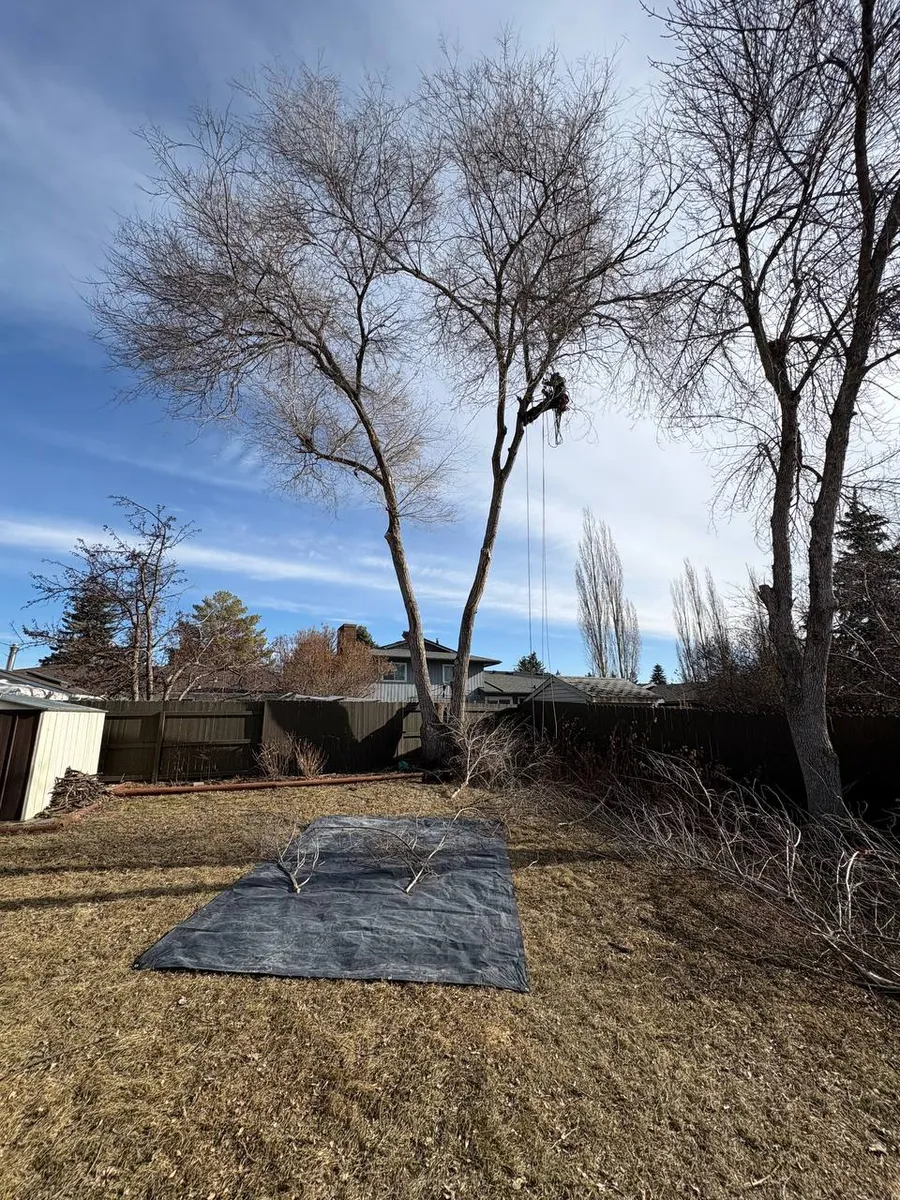
Storm work isn't routine removal. The tree is already partly failed, the load paths are unpredictable, and the property under it is usually already damaged. Our process is shaped around that:
Assess
Walk the site. Identify load paths, structural integrity, fall zones, and any access constraints (tight backyards, fence lines, neighbouring trees). Confirm the line is de-energized if applicable. Decide on rigging strategy before any cut is made.
Safe-off
Rope off hazard zones. Stabilize any limbs still under tension with rigging lines. If the tree is on a structure, plan the lift so we don't make the damage worse during removal.
Sectional removal
Storm-damaged trees are almost always taken down in pieces, not felled. We rig each section, lower it controlled, and clear the cut before the next piece comes down. Crane work for the largest sections when a tree is on a roof and conventional rigging would risk further damage.
Cleanup
Full debris removal — wood, chips, sawdust, raked yard. Included on every job. Some homeowners want to keep firewood; we'll cut and stack it if requested (with the elm-wood exception per Alberta law).
Documentation
Before-and-after photos, written description of the work performed, itemized invoice. Everything you need to file with your insurer. If they want to talk to us about the work, we're happy to take the call.
Insurance claims in Alberta — how they actually work
Most Calgary homeowners are surprised by what their policy does and doesn't cover. The short version: insurance pays when a tree damages something else, not the tree itself. Five things worth knowing before you call your adjuster.
What's usually covered
Damage to a covered structure — house, garage, attached deck, fence, shed listed on the policy. The structural repair itself is the main payout. Debris removal is typically included but with a sublimit — often $500 to $2,000, capped lower than you'd expect. Other-structures coverage sometimes pays for a tree-damaged fence even when no main building was hit, depending on the policy.
What's usually not covered
Tree on the ground, no structure hit. If a tree falls and lands harmlessly in the yard, removal is typically out-of-pocket. The tree itself. Replacement cost of the tree as a landscape feature is almost never covered. Cosmetic damage with no structural impact. Damage from a clearly diseased or visibly hazardous tree the homeowner was on notice about — some insurers will deny these claims as preventable.
Who's responsible if a neighbour's tree falls on your property?
This is the most common question we get, and the answer is the opposite of what most people expect. In Alberta, damage from a neighbour's tree is generally your own insurance's responsibility, not theirs. The only exception is if you can prove the neighbour was on documented notice that the tree was hazardous and ignored it. Your insurer may try to recover from theirs, but you file with yours first.
What we provide for your claim
Dated photos before we touch anything, photos of the work in progress, photos of the completed cleanup. Written description of what was done and why. Itemized invoice with materials and labour broken out. Receipts for any emergency mitigation. This is what adjusters need for a standard storm-damage claim.
Assessing surviving trees
When the obvious damage is dealt with, the work isn't quite done. Trees that didn't fail can still be compromised — and a tree that comes down in next month's wind is much more expensive than one removed planned. Walk every mature tree on the property and look for five things:
New lean
Compare to memory or old photos. A trunk that's started leaning even slightly post-storm has root failure underway. Don't wait for it to finish the job.
Exposed or lifted roots
Look for fresh soil cracking, mounding, or visible roots that used to be buried. Same diagnosis as new lean — root plate is failing.
Cracks in major unions
Especially codominant stems. Splits that were hidden may have opened during the storm but haven't gone all the way yet. Often visible from underneath as a thin dark line in the bark.
Hanging limbs (widow-makers)
Broken branches caught in the canopy. Will fall — the question is when, and onto what. Most can be removed quickly during the same visit if we catch them on the cleanup pass.
Peeled or stripped bark
Hail or impact damage that didn't break the tree but exposed the cambium. Doesn't kill the tree immediately, but creates infection sites and weak points for next year.
Mushrooms at the base
Fungal fruiting bodies on the trunk or root flare — bracket fungi, honey mushrooms, conks — are a red flag for internal decay. Often easier to spot in the wet conditions after a storm. A tree with visible base fungi has compromised structural wood.
Preventing the next failure
You can't storm-proof a tree. You can reduce the odds of any one tree being the one that fails. Four interventions, in rough order of effectiveness:
Strategic pruning to reduce sail and weight
The single highest-impact preventive measure. Crown thinning lets wind pass through. Selective limb reduction takes weight off the long horizontal branches that catch snow. Done by someone who knows what they're doing — never as topping.
Cabling weak unions
Steel cables high in the canopy distribute load between codominant stems so they can't pull apart. Standard arborist work on otherwise-healthy mature trees that have a known structural weakness. Lasts decades. Inspected periodically.
Removing trees with serious defects
Sometimes the answer is: this tree is going to come down. Better it comes down on a Tuesday in October than at 3am during a chinook. The hardest conversation we have with homeowners — but the right one.
Structural pruning of young trees
The cheapest insurance there is. Prune young trees for good structure — single dominant leader, well-spaced scaffold branches, no codominant stems — and you avoid 80% of the problems we deal with on mature trees. Almost no one does this.