Black Knot in Calgary
How to identify it, cut it out properly, and stop it spreading through your yard.
🌳 Quick Reference
- What it looks like
- Hard, black, cracked swellings wrapped around branches — like burnt marshmallow or a lump of coal
- Trees affected
- Mayday, Schubert chokecherry, chokecherry, plum, cherry — the Prunus family
- Best time to prune
- Late winter — fungus is dormant, knots are easy to spot with no leaves in the way
- Where to cut
- 15–20 cm (6–8 in) below the knot, into clean wood
- Between every cut
- Sterilize tools — 1 part bleach to 3 parts water, or 70% rubbing alcohol
- Disposal
- Burn, bury, or bag for landfill. Not the green cart. Not a pile in the yard.
- Is there a cure?
- No. No spray or fungicide eliminates it. Pruning is the only control.
- Will it kill the tree?
- Eventually, if left alone for years. Managed properly, most trees live with it.
What black knot actually is
Black knot is a fungal disease that infects trees in the Prunus family — cherries, plums, and their ornamental cousins. The fungus gets into a branch, and over two seasons it builds a hard, black, woody gall that wraps around the wood and slowly strangles everything past it.
It is not rare here. It is one of the most common tree problems in Calgary, and it's a direct result of what got planted in this city. Mayday and Schubert chokecherry were planted heavily across Calgary because they're among the trees that reliably survive the chinook zone — which means an enormous number of yards have a host tree standing in them.
The spores travel on wind and rain. That means your neighbour's untreated tree is a genuine reinfection source for yours, and it's why black knot tends to move through a block rather than hitting one yard in isolation.
How to identify it — and why year one is easy to miss
Black knot doesn't appear fully formed. It develops over roughly two seasons, and the stage most people notice is already the second one.
First season — olive-green swelling
A soft, slightly swollen olive or brownish-green section of twig. Easy to walk straight past. This is the stage where removal is cheapest and most effective.
Second season — hard and black
The gall hardens, turns black, and cracks. This is the classic "burnt marshmallow" look. It is now actively releasing spores each spring.
Advanced — girdling and dieback
Knots ring the branch completely, cutting off flow. Branches above die. Knots on the trunk or main leaders are the serious case.
What it isn't
A few things get mistaken for black knot. Burls and old pruning callus are smooth and the same colour as the bark. Frost cracks run vertically along the trunk rather than wrapping a branch. Cankers are usually sunken and dead-looking rather than swollen and lumpy. Black knot is distinctive once you've seen it: swollen, coal-black, cracked, and wrapped around the wood.
Which Calgary trees get black knot
🤍 Mayday
The fragrant white-blossom tree planted all over Calgary. Highly susceptible.
💜 Schubert chokecherry
The purple-leaf one. Extremely common here, and commonly infected.
🌿 Native chokecherry
The clump-forming shrub. Susceptible.
🍒 Plums, cherries, apricots
Including ornamental and fruiting varieties.
When to prune black knot out
Late winter is the right window, and it's not a small preference — it changes how well the job works.
The fungus is dormant. Spores are released in spring, when the tree is wet and actively growing. Cutting in spring means you are opening fresh wounds at exactly the moment spores are in the air.
You can actually see the knots. No leaves means every gall on the tree is visible. In full summer foliage, it's easy to miss half of them — and a half-pruned tree reinfects itself.
Cuts are cleaner. Dormant wood, no sap flow, faster sealing once spring arrives.
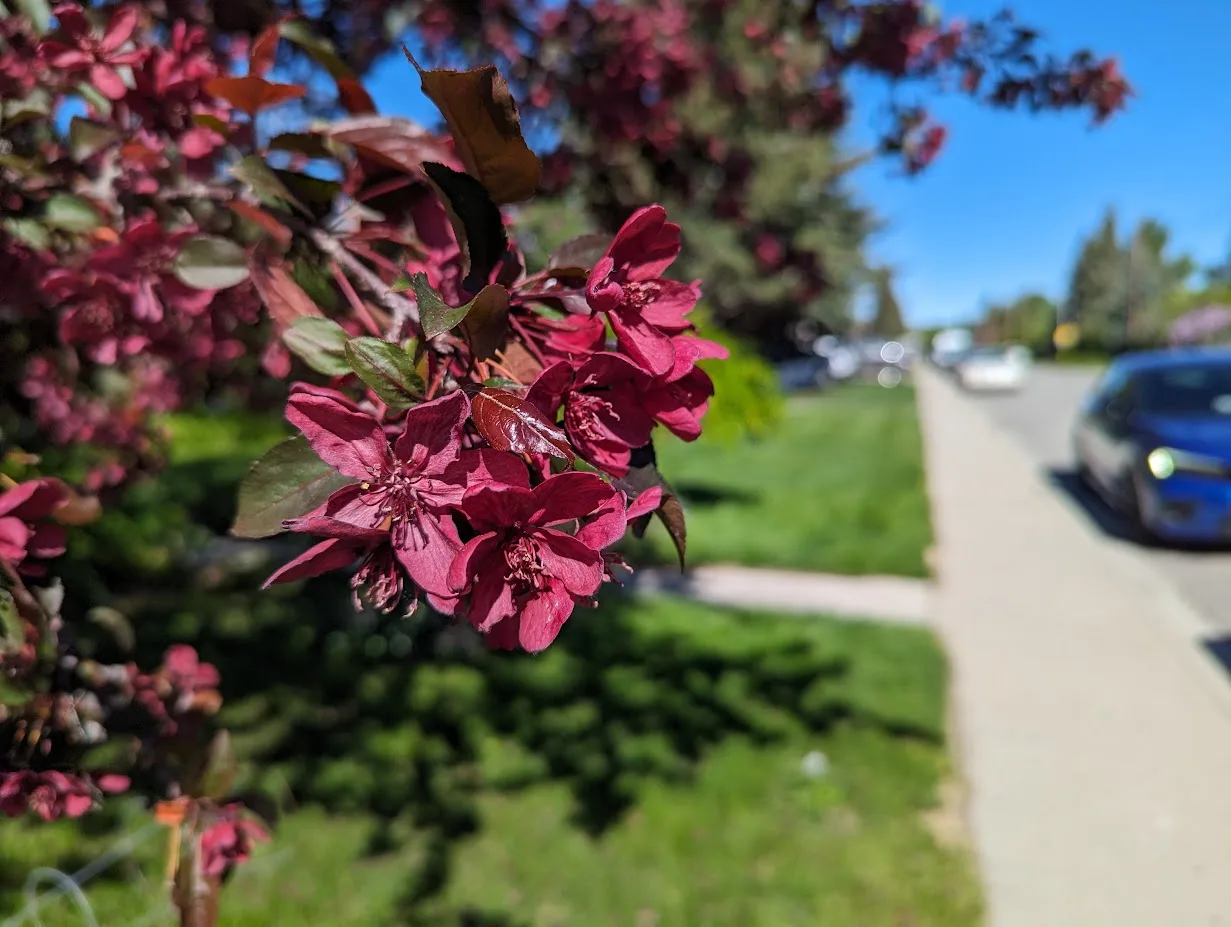
Related reading: our spring pruning guide for what else to prune in the same window, and the complete tree pruning guide for technique.
How to cut it properly
The single most common mistake is cutting too close to the knot. The fungus grows inside the branch, past the visible gall — so cutting right at the edge of the black lump leaves live fungus in the tree and it comes straight back.
How far below?
Guidance varies. The City of Calgary's minimum guidance is 2–4 inches below the knot; most arborists and the CBC coverage of Calgary's outbreak recommend 6–8 inches. We cut 15–20 cm (6–8 in) below — the extra margin costs you a little more branch and buys a much better chance the fungus is actually gone.
- Cut 15–20 cm below the visible knot, into clean wood
- Sterilize between every single cut — 1:3 bleach/water, 70% alcohol, or methyl hydrate
- Work in dry weather
- Cut just outside the branch collar, no stubs
- Check the whole tree before you start, so you know the full scope
- Inspect every year — this is ongoing management, not one job
- Shave or scrape the knot off and leave the branch
- Cut at the edge of the black gall
- Move between cuts without sterilizing — you're inoculating clean wood
- Prune in wet spring weather when spores are active
- Take more than about a third of the canopy in one year
- Leave the prunings anywhere on the property
If the knots are on the trunk or a main leader, pruning isn't an option — you can't remove a structural stem the way you'd remove a branch. That's the point where the conversation shifts to whether the tree is worth keeping.
Disposal — the step most people skip
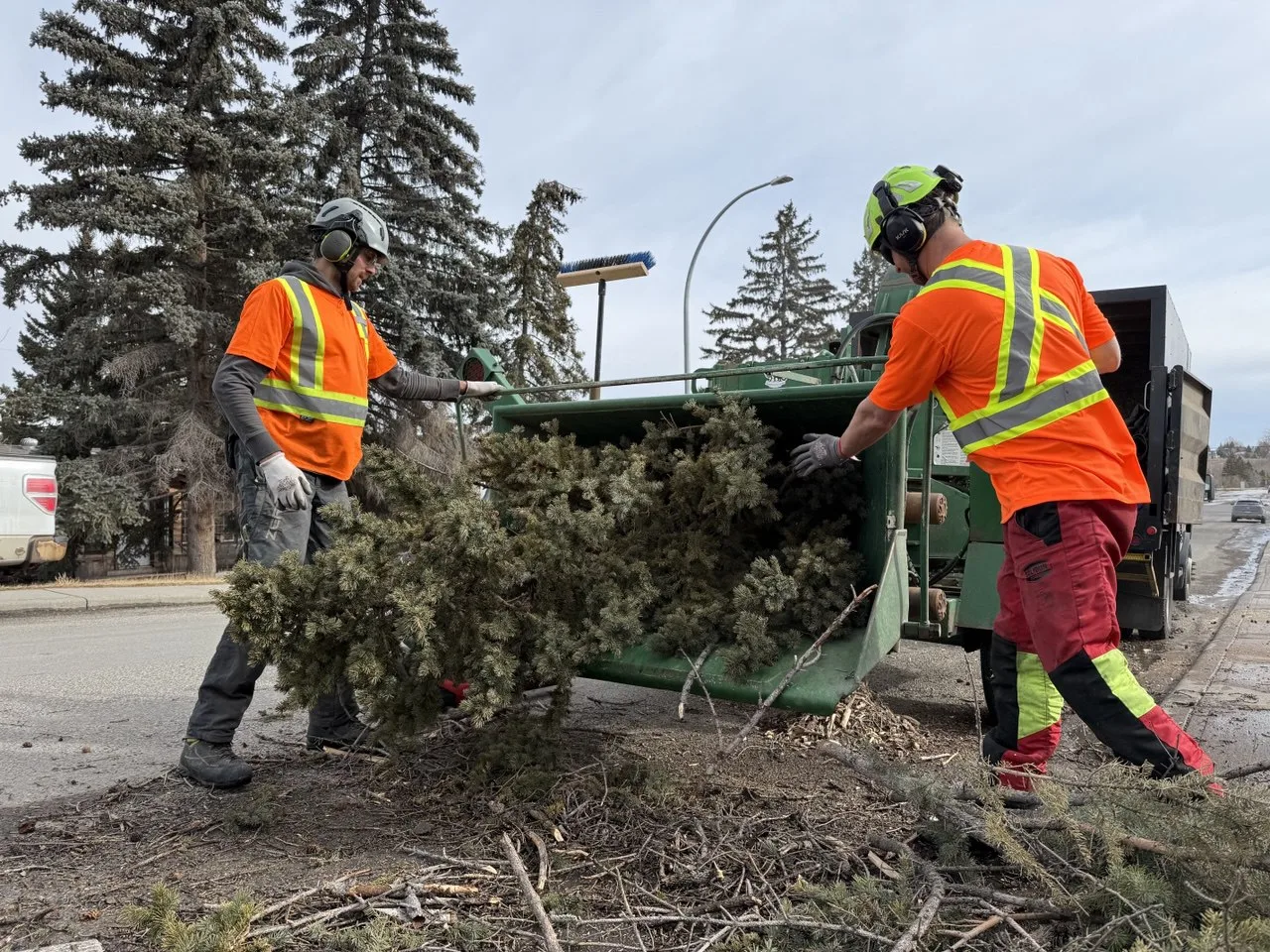
This is where a lot of well-intentioned pruning fails. A knot that has been cut off the tree can keep releasing spores for up to four months. A pile of infected brush sitting behind the garage is a spore factory pointed directly at the tree you just pruned.
If we do the work, disposal is included and the infected material leaves your property the same day. That's not an upsell — it's the part that determines whether the pruning actually worked.
Not sure how bad yours is?
Send a couple of photos and Tony will tell you straight — whether it's early enough to prune out, how much of the tree is involved, and what it would cost. No charge, no obligation.
Can the tree be saved, or should it come out?
Most infected trees can be kept. The City of Calgary's own position is that black knot won't necessarily kill a tree if it's managed properly and infected branches are removed. Managed means annually, not once.
- Knots confined to smaller branches out in the canopy
- Less than roughly a third of the canopy involved
- Trunk and main leaders clean
- You're willing to have it checked every year
- Knots on the trunk or main structural leaders
- More than about half the canopy infected
- Major dieback already — large dead sections
- Years of infection with no management, so the structure is compromised
There's a middle case worth naming honestly: a heavily infected tree can sometimes be pruned back hard enough to survive, but you end up with a thin, oddly shaped tree that takes years to look right and needs annual attention. Sometimes that's worth it for a mature tree in the right spot. Sometimes replanting is the better decision. That's a judgement call best made looking at the actual tree.
If removal is the answer, see our tree removal guide and what removal costs in Calgary.